
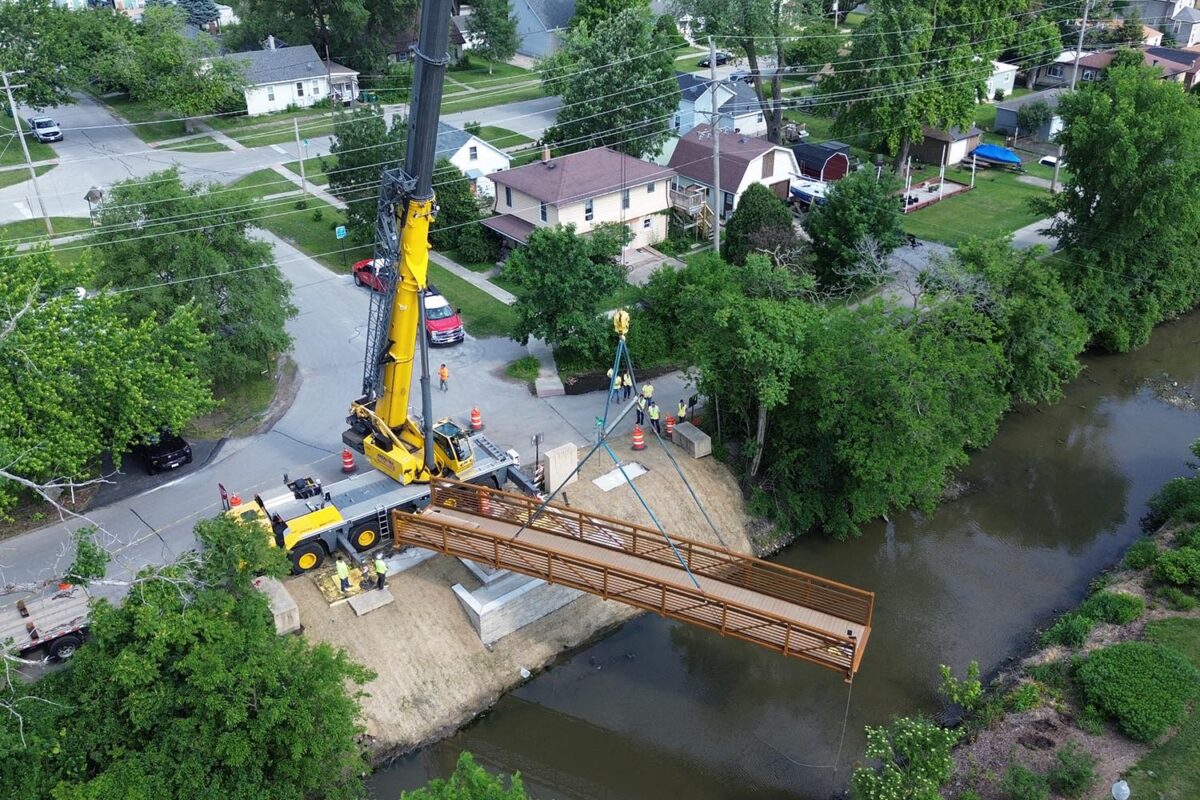
In the world of transportation and civil engineering, sometimes it is the small but mighty projects that inspire our imagination and directly enhance our lives. The 8th street pedestrian bridge project for the City of Lockport is an inspirational small but mighty project. More than a pedestrian crossing, the bridge connects eras, weaving the site’s industrial past into its present-day identity and standing as a quiet homage to the history that continues to shape the community. The project received the APWA Southwest Branch 2026 Project of the Year in the category of Historical Preservation: <$5 million.
Civiltech provided Construction Engineering services on this project replaces an existing pedestrian bridge over the I&M Canal, and with the new bridge, provides a pedestrian connection between residential areas and downtown Lockport including Lincoln Landing, the Historic Gaylord Building, Illinois and Michigan (I&M) Canal Trail, and the Lockport Historic District. The Lincoln Landing is an open-air park and museum that celebrates the original Illinois and Michigan Canal lines and is immediately adjacent to the bridge.
The project embraced the site’s history by incorporating the existing abutments, preserving the stonework of the eastern side and honoring its timeless aesthetic, while a new structural wall was constructed around the western abutment and clad in stone so that old and new meet seamlessly, echoing the craftsmanship of generations past. Design engineers studied high-water elevations with precision to ensure the bridge’s low chord aligned with modern flood standards while remaining sensitive to the natural rhythms of the canal.
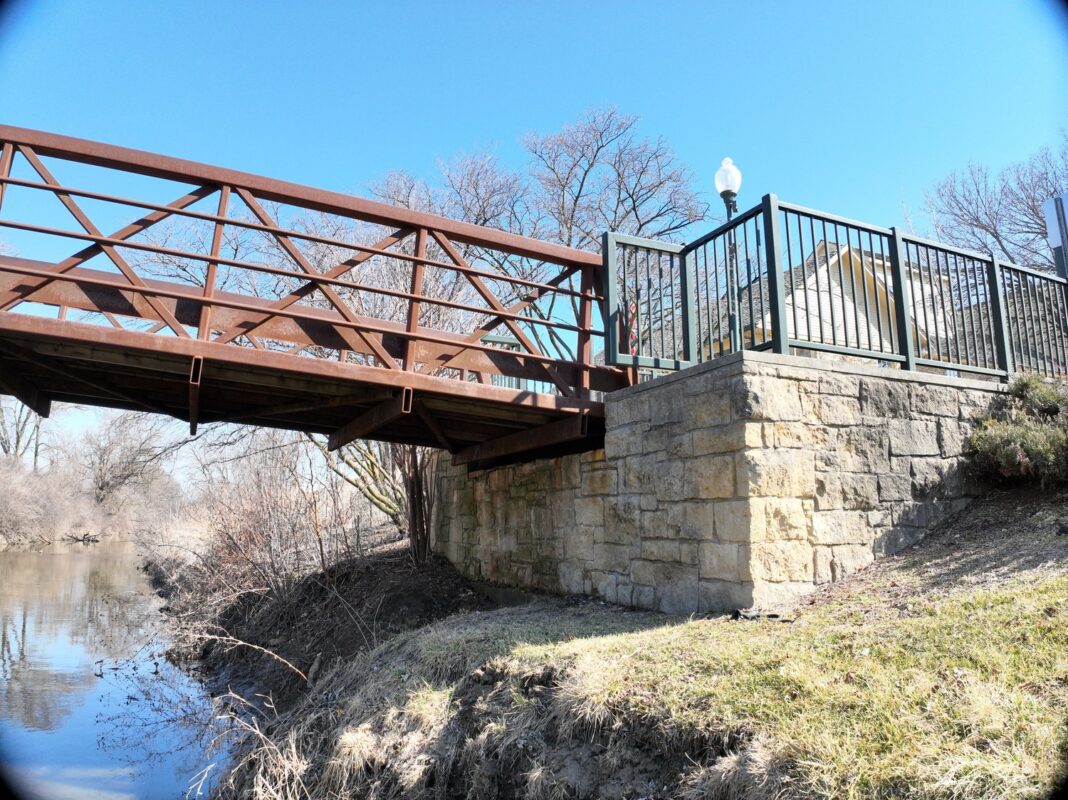
The prefabricated bridge, built of weathering steel, was chosen not only for its strength but also for its ability to blend gracefully with the surrounding stone, industrial heritage, and historic landscape, creating a structure that feels as though it has always belonged, harmonizing with its neighbors: Lincoln Landing, the Gaylord Building, the I&M Canal, and the heart of downtown Lockport.
The historic components of this bridge replacement project required outstanding construction management and delicate construction. The centerpiece of the project was to preserve the existing historic abutments and their stone features while placing the new bridge structure. The east side of the bridge had a stone abutment that was partially exposed. The west side abutment had not previously been exposed and was made of concrete. New foundation walls were built in front of the abutments to support the new bridge. On the west side, the concrete abutment and new structural walls were wrapped in stone to match the historic aesthetics of the existing east side abutment.
The Construction Engineering team had to ensure that the contractor worked meticulously in the Lincoln Landing area. The site includes historic markers built from large slabs of stones that feature an explanation of the area and history. Also, on the east side of the canal was a stone that was used by the original family as part of the historic abutments. Many of these markers needed to be removed prior to dismantling the existing bridge. This work was done by hand. Stones were carefully removed, cataloged, preserved, and reinstalled. Also, brick pavers were dismantled by hand and reinstalled in their original pattern.
While the bridge design reused the historic abutments as a design feature the bridge itself is a modern prefab unit that was built off site saving time and expense. The bridge was designed to blend with the historic elements of the site. The steel material utilized was initiated by the City to ensure that the bridge had an attractive weathered patina.
All connections were prepared prior to the installation of the prefab bridge. Therefore, installation included simply placing it with a crane and completing the connections. 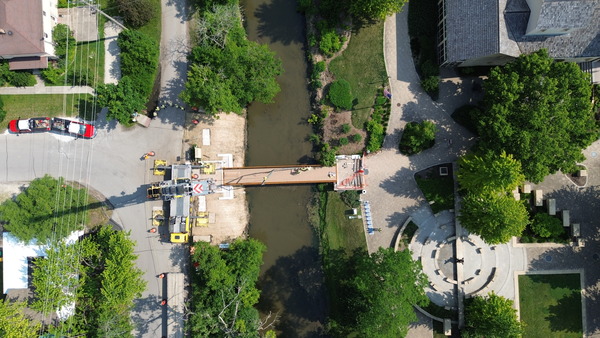
Maintaining and preserving the historic nature of the site was critical to the success of this project. In addition to the meticulous construction techniques to work around the historic stone abutment, other historic considerations were required. The project required a SHPO permit from the State Historic Preservation Office due to its proximity to the Gaylord Building Historic Site. The Gaylord Building is a historic building from the 1830’s located in Lockport’s downtown, adjacent to the canal.
The new bridge and construction fit into the existing footprint of the previous bridge, therefore, elevations that work with the canal’s floodway elevations were maintained. As such, no environmental permitting or studies were required. The Construction Engineering team had extensive coordination with the IDNR throughout the construction.