
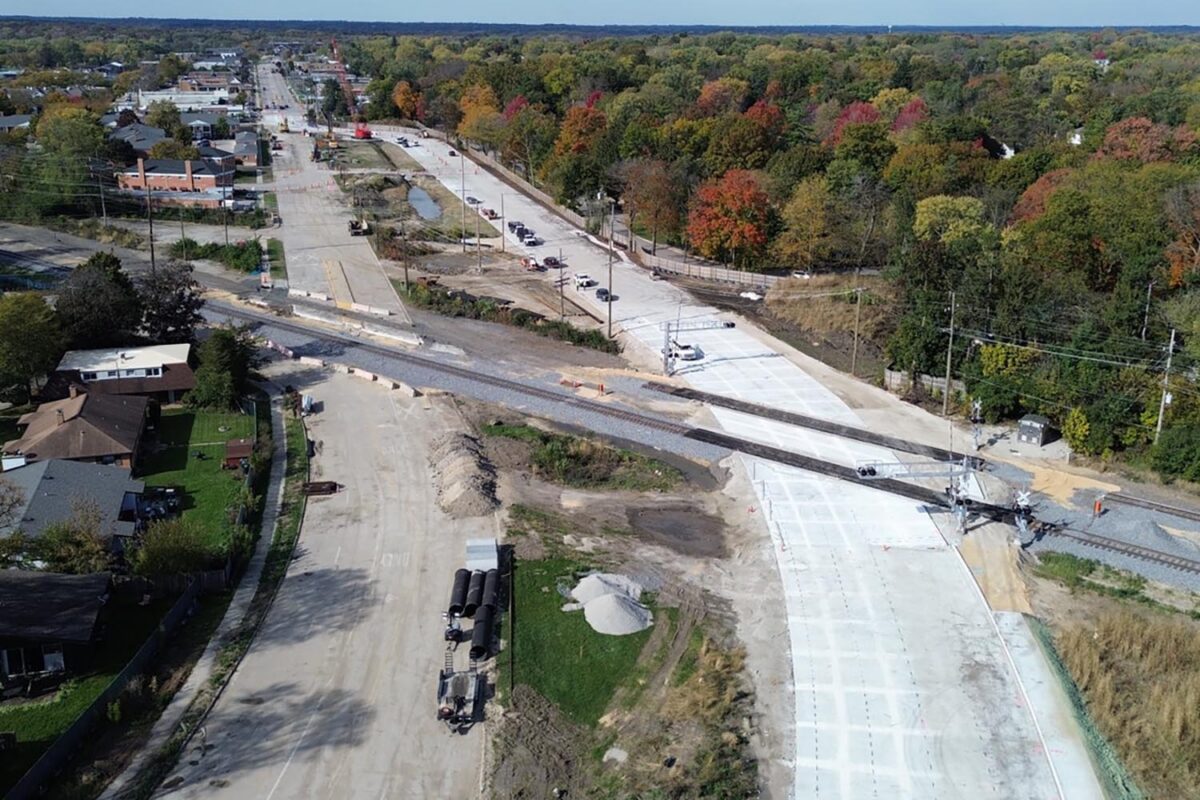
Imagine a construction site the size of a few city blocks that is receiving a new railroad bridge, two new massive box culverts, a 45-foot-deep pump station, retaining walls, a relocated waterway, and a new 4-lane highway—where beginning the construction of each item is dependent on something else finishing first. The US Route 14 Grade Separation project in the Village of Barrington is an intricate construction puzzle with each piece dependent on the completion of one before it. Civiltech is providing Construction Engineering services for this complex project, led by Resident Engineer, John Vogelman, P.E.
An Ambitious Project to Relieve Traffic Backups
The CN Railway acquired the EJ&E Railway in 2008 to serve as a bypass around Chicago. As a result, the volume and length of freight trains on the rail line are expected to increase significantly. The rail line had crossed three important arterial routes at grade within the Village, and traffic studies predicted considerable impacts to vehicular mobility and emergency response times, especially during peak commute hours. To mitigate impacts, the Village secured a federal TIGER-II Planning Grant to analyze alternatives for a grade separation at the US Route 14 at-grade crossing, where nearly 30,000 vehicles per day cross the tracks.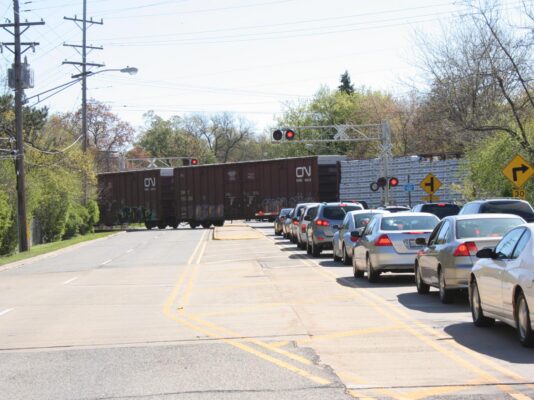
The alternatives studied included a US Route 14 overpass or underpass, a railway overpass or underpass, and a partial raising or lowering of the railway or highway. Civiltech provided Phase I Environmental and Design Studies services and led extensive public outreach and coordination between the Federal Highway Administration, Illinois Department of Transportation (IDOT), and the Village, resulting in a highway underpass selected as the preferred alternative. Civiltech then provided Phase II Design Engineering which was completed in 2024.
Setting the First Pieces: A Temporary Road and Rail Crossing
As construction kicked off in early 2025, a significant first step was to build a temporary 4-lane highway or ‘runaround road’. The 4-lane runaround road had to be constructed before a temporary at-grade railroad crossing could be installed, which in turn had to be completed before excavation of the railroad bridge could begin. Completing the temporary road and tracks in 2025 marked the project’s critical first steps clearing the way for the project construction to begin.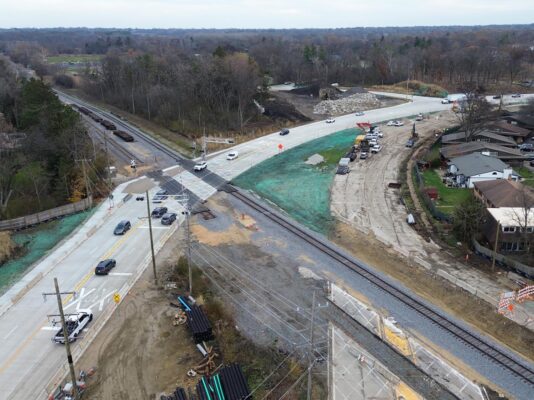
A New Railroad Bridge Takes Shape
In 2026 the construction activities focused on a range of significant components, one of which is the construction of the new bridge that will carry the railroad over Route 14. The bridge has two spans with an abutment on each end and a pier in the middle. The abutment stems and back walls will receive an architectural form-liner finish for a stack stone aesthetic with a rubbed-finish band at the top. The abutment back walls will feature ornamental railings.
Construction started with the abutments and the center pier. Once both abutments and pier are complete, work will begin on the bridge’s steel girders, then the deck. The deck will receive waterproofing and be topped with ballast. The construction work administered by Civiltech includes all the railroad infrastructure up to the bottom of the ties, including the stone bed under the ties. When the bridge deck is complete, the railroad contractors will set the track.
The construction of the railroad infrastructure involves detailed scheduling and careful coordination with the railway. To manage their rail traffic, the railway requires precise notification of construction activities, and the construction team needs to ensure that they are then ready at the time agreed upon. Coordination involves bi-weekly meetings with extensive schedule review. The railroad bridge construction is unique to this project in general as railroad underpasses are not common projects in our region.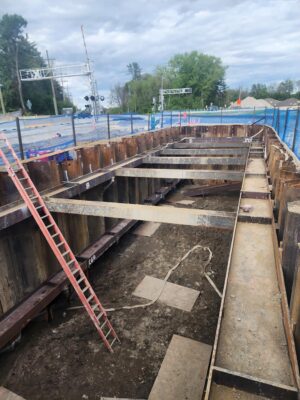
Diverting Water and Holding Back Earth
An existing Flint Creek tributary impacts the project site. The project includes the construction of two massive box culverts that will allow the relocated creek to pass under the roadways. A 30-ft. wide by 10-ft. high structure crossing under Route 14 has been completed, and a 50-ft. wide structure crossing under Route 59 is under construction. The creek relocation work will begin when the culverts are completed.
A pump station is required to remove storm water from the forthcoming underpass. The building, also being completed in the 2026 season, has a 45-ft. deep basement that will collect stormwater from the underpass. The completion of the pump station is required before excavation for the underpass can begin.
Adding to the variety of structural components, noise walls and retaining walls flank the underpass. Like the railroad abutments, the concrete walls are finished with architectural form liners for a highly aesthetic, stone appearance.
Bringing All the Pieces Together
All these significant structural pieces need to be in place before excavation and construction of the underpass can begin. The railroad bridge needs to be completed, and the rail traffic put back on the bridge, the culverts need to be completed for the road to cross over, and the drainage and storm sewer work needs to be completed to function during the excavation of the underpass.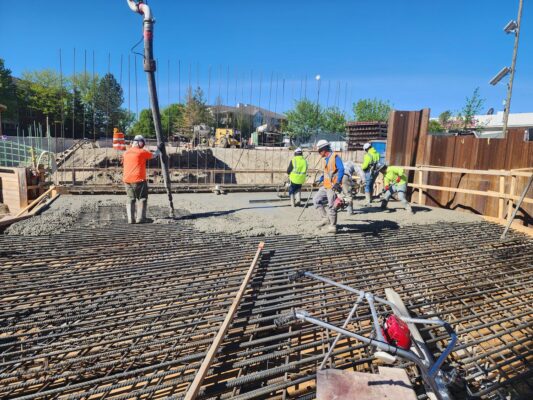
Challenges
With so many moving parts and varied construction components, coordination and communication continue to be critical. Not only are there many contractors on the project, but extensive coordination is required with the railroad work and utility work. Due to the massive size of the box culverts and the underpass, utility relocation was significant.
For Civiltech’s Phase III team, the biggest challenge to date was coordination with the railroad which adds a layer of approvals to the process. As described earlier, the railroads require significant advance notice and precise scheduling for their work. The Phase III team must ensure the site is ready for the railway work at the time agreed upon.
The presence of the creek tributary within the project parameters presents environmental challenges. With construction activities occurring adjacent to the creek and the creek receiving the water pumped from the excavations, the creek must be protected and the water kept clean. The Contractor is responsible for filtering to ensure water returning to the creek is clean. A variety of methods are being used including filter bags and a tank filtering system. Civiltech’s Phase III team is responsible for inspecting the process and monitoring the water condition.
Maintenance of traffic would normally be a difficult challenge on a project of this complexity. However, the 4-lane temporary highway has provided a smooth approach as traffic has not had to be reduced except for a road closure early on. The maintenance of traffic effort has been enhanced by proactive Village communications using a website with project updates. This has been especially critical when preparing for a major traffic shift or a road closure. A lot of staging occurred in 2025 which included shutting down Route 14 for over a month. The website kept the public notified of those construction events.
Complexity in a Small Footprint
John shared that one of the most interesting aspects of the project is that the project is large in complexity, features, and cost but set in a small footprint. The construction of the railroad bridge, two large culverts, noise and retaining walls, a pump station, and a creek relocation as well as the forthcoming underpass highway all work together creating a significant project of large interrelated structural components occupying a small project area just over a half mile in length.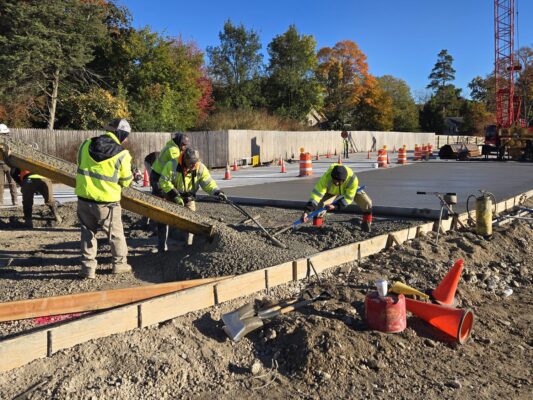
John stated that he is looking forward to the excavation of the underpass. Not only will it mark the beginning of the final phase of the project, but the excavation itself may prove interesting. The excavation will lower the grade for the new roadway by 25 feet at its lowest point with over 100,000 cubic yards of earth being removed. With that extensive demolition, John says it will be interesting to see what the earth offers up; to see if old structures, irrigation systems, or other buried pieces of history are uncovered.