
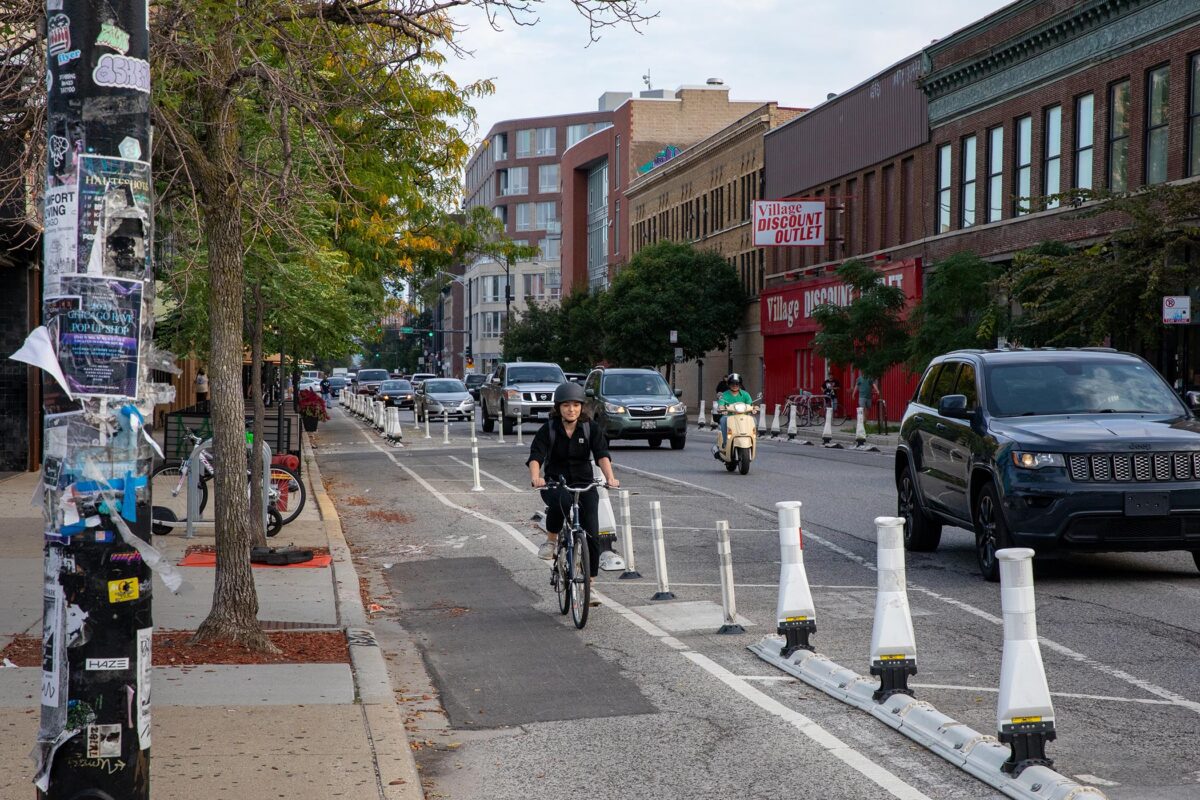
Redesigning urban streets to provide dedicated bikeways provides myriad benefits that are well documented and recognized by cities throughout the country. These benefits include creating equitable, multimodal transportation networks that calm traffic speeds, increase comfort and safety for all roadway users, reduce bike crashes, support healthy lifestyles, and even result in cleaner air.
However, when considering installation of dedicated bike lanes along an urban corridor, one concern among stakeholders stands out. Will bike lanes negatively impact the businesses and economy? This question is especially relevant if the design includes the removal or consolidation of existing street parking.
Starting in 2023, the City of Chicago Department of Transportation (CDOT) partnered with Civiltech to undertake a study of the economic impacts of bike lane installations to aid in their bike network planning and stakeholder coordination. Civiltech worked with CDOT to study six commercial corridors with recent dedicated bike lane installations and publish case study summaries. The Economic Impacts of Bike Lanes study was led by Civiltech’s Transportation Planning team with the Graphic Design team assisting on the creation of the report.

Civiltech analyzed candidate corridors using a variety of data sets and a consideration of the geographical distribution across the City and recommended the six corridors to be studied. Each corridor was paired with a nearby control corridor with similar attributes but without a bike lane, which allowed the study metrics to be compared between the two.
The team then reviewed data sets using both transportation and economic metrics to determine what would be assessed in each corridor. The variety of metrics used in the study included tax revenues, employment, property values, and commercial vacancies as well as transportation metrics such as changes in bike traffic.
Public outreach was a critical research and data collection component. Surveys were utilized to collect feedback from community members and local businesses. The team met with realtors, developers, and local business focus groups. Meetings with community members provided local insights on the use and activity of the corridor and any changes following bike lane installation.

The study concludes that overall, bike lanes did not negatively impact businesses and economics of the corridors. While some corridors experienced improved economies and increased bike traffic, the study did not show causation. The improvements could not be definitively attributed to the bike lanes. Thus, the addition of bike lanes can be seen as neutral in their impacts to local businesses and economies.
Due to strong interest in the study, case studies are now available to the public. These serve as a meaningful reference for CDOT to provide to community representatives when planning new bike network projects.